Kudos to the WSJ for publishing these articles. It takes guts to shine light on a topic that’s sure to cause heartburn in the CEOs of some of Wall Street’s Internet darlings. And the IAB. Do I sense moral courage? What’s the world coming to! Have a look…
From the Sites Feed Personal Details To New Tracking Industry July 30th:
The largest U.S. websites are installing new and intrusive consumer-tracking technologies on the computers of people visiting their sites—in some cases, more than 100 tracking tools at a time—a Wall Street Journal investigation has found.
The tracking files represent the leading edge of a lightly regulated, emerging industry of data-gatherers who are in effect establishing a new business model for the Internet: one based on intensive surveillance of people to sell data about, and predictions of, their interests and activities, in real time.
….
If “you were in the Gap, and the sales associate said to you, ‘OK, from now on, since you shopped here today, we are going to follow you around the mall and view your consumer transactions,’ no person would ever agree to that,” Sen. George LeMieux, R-Florida, said this week in a Senate hearing on Internet privacy.
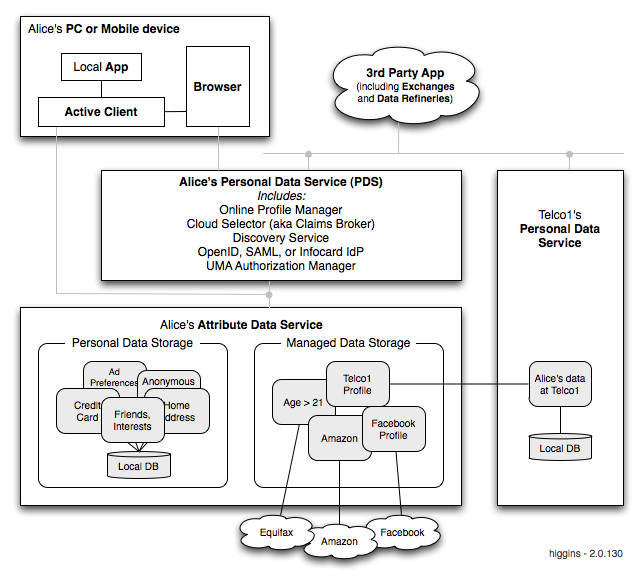
Active clients and personal data stores resolve these thorny privacy issues in the best way possible. Why? because they shift of control of capture and disclosure of a person’s data to the person.
The online advertising industry will eventually get there. The FTC will too. The EU is getting there fastest. See for example, Making the FTC Look Tame: The EU Targets Behavioral Profiling in the July 26, 2010 in Privacy & Security Law Report:

Last month, Europe took a major step toward a notice and opt-in regulatory model for behavioral advertising. On June 22, the Article 29 Working Party, the EU-level data protection advisory body comprised of representatives of all EU member state data protection authorities, issued a detailed and very restrictive opinion on online behavioral advertising. The opinion requires network advertisers to obtain user opt-in to placement of advertising cookies on user devices, to provide prominent notice of profiling, and to erase cookies periodically. It also requires website publishers to inform the visitors about the ad network used and the profiling that takes place. The Working Party will reach out to industry stakeholders and invites public comment and a “dialogue” with industry regarding how to implement the broad principles it articulates in the opinion
And then again on the same day (July 30th) from the WSJ: The Web’s New Gold Mine: Your Secrets. A Journal investigation finds that one of the fastest-growing businesses on the Internet is the business of spying on consumers. First in a series.
And checkout the excellent What They Know tool. Graphics, data, explore!


 Well, here’s a new organization,