Personal Data Service vs. Personal Data Store
I share Drummond’s perspective on this issue. When I describe the concept of a Personal Data Store to techies I’m constantly having to explain that it’s about centralizing control over personal data, but not centralizing its location.
David Siegel calls it a Personal Data Locker, others Personal Data Space or Personal Data Vault. W3C folks are working on Personal Data Wiki. I was just on a VRM call today. At Drummond’s suggestion a bunch of us are going to try to create wikipedia entries, and hopefully a diagram (as Iain Henderson suggested) that define some common terms. It would be helpful at this early “market development” stage to have a common set of terms that developers and techies can understand. Here are my contributions:
Terms:
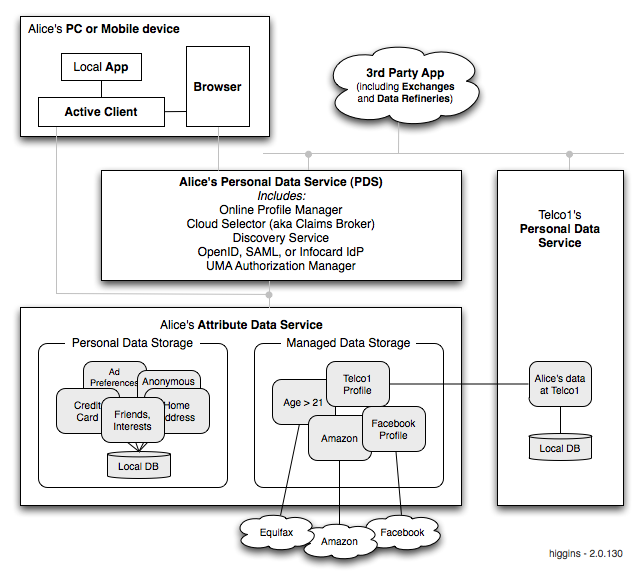
- Personal Data Service (PDS) – A service that enables the user to participate as a peer within a distributed personal data ecosystem. A PDS provides one or more of the following services: (a) a web portal that provides a dashboard view of the user’s data, the ability update self-asserted data, and a way to manage authorizations (e.g. using something like an UMA Authorization Manager) and set policies under which 3rd parties gain access to portion of the user’s information, (b) supports a Discovery API that allows you to be discoverable by other people, organizations, apps and exchanges whose inquiries that meet criteria you specify, and (c) provides an identity provider (IdP) endpoint (e.g. OpenID OP)
- Attribute Data Service – Service that (A) locally stores your self-asserted data attributes, makes them available via APIs, and supports active clients. Ideally these self-asserted data are stored in encrypted form using a key that the PDS operator does not know. It also (B) maps data from both external data services (e.g. Facebook, etc.) as well as from external Personal Data Services (e.g. your friend’s PDS or a PDS managed by your favorite telco), makes it all available via APIs (e.g. XDI, SPARQL, oStatus, etc.), and supports active clients.
- 3rd Party App – A web app that consumes data from the PDS. These include information refineries –a kind of app that reads datasets from the PDS, refines them, and writes them back to the PDS user. The refinery process includes analytics, inferencing, segmentation, etc. Refineries generally to create higher value, more refined data from the more raw forms of data, while often also making the data sets less personally identifying. These also include information exchanges–a kind of PDS App that is involved in creating personal data exchanges analogous to a stock exchange. An exchange itself is a platform that supports yet another layer of apps above it [this is not shown above].
Couldn’t resist drawing a picture: